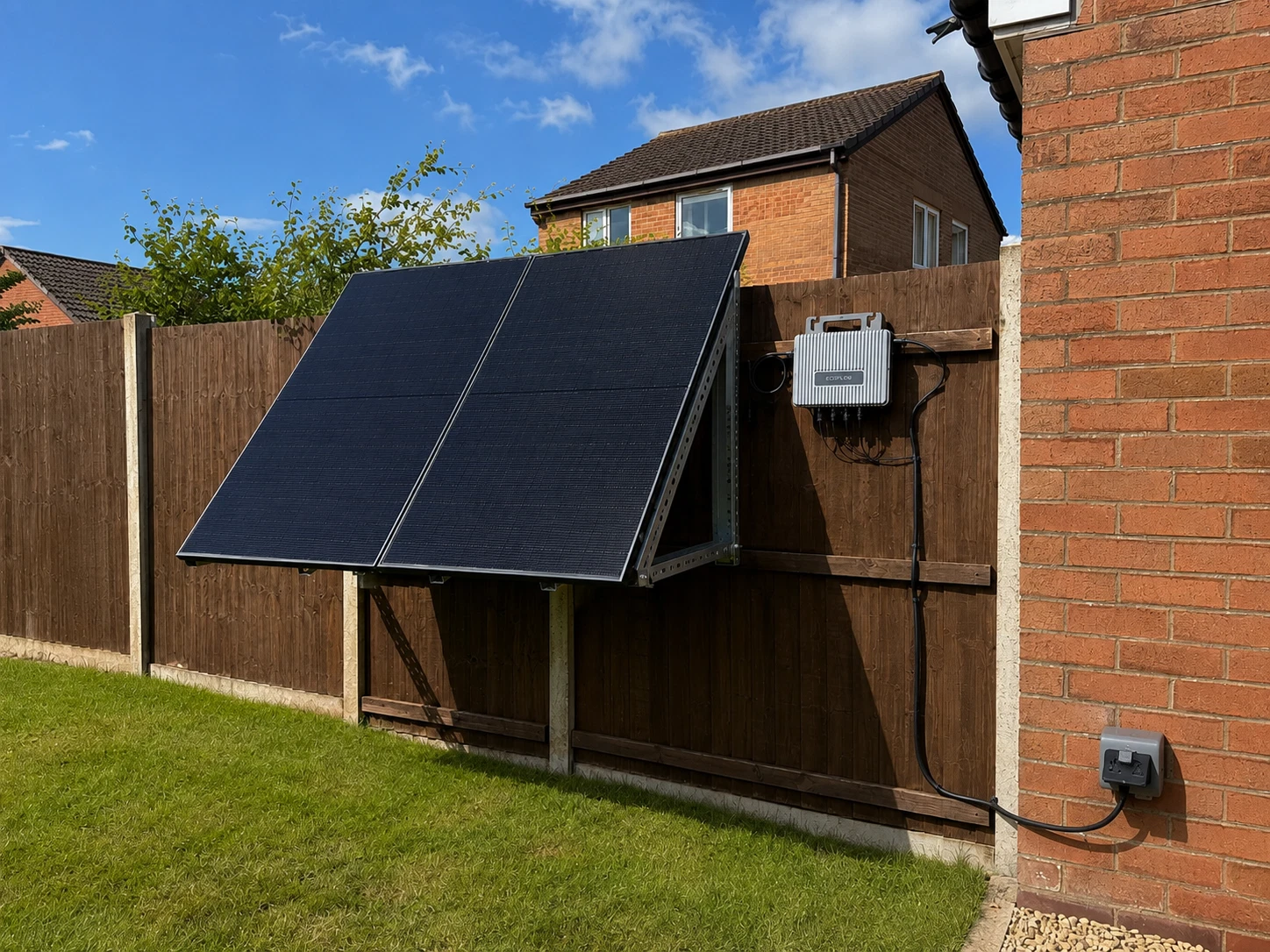
"Plug-in solar" — a small panel and inverter you connect straight into a normal wall socket, no electrician required — has been sold in the UK for a while, but it sat in a legal grey area. Building regulations and DNO connection rules were written around a professional, hard-wired installation, and a device you simply plug in didn't fit neatly into either. That changed on 27 August 2026, when new rules came into force setting out, for the first time, exactly what is and isn't allowed.
If you've seen plug-in panels advertised for balconies, patios or garden fences and wondered whether they're actually legal now, here's what changed, what the rules require, and how it compares to a conventional rooftop solar system.
What Changed on 27 August 2026?
Following a government consultation earlier in the summer, a statutory instrument (SI 2026/896) brought plug-in solar within England's permitted development rules. It defines plug-in solar as photovoltaic panels "intended for connection to the relevant domestic premises' electricity installation by means of a standard plug and socket" — in other words, exactly the kind of balcony or patio kit you'd previously bought without much regulatory clarity.
In practice, this means many plug-in solar installations in England can now go ahead without a separate planning application, provided they stay within the limits set out below. It's worth noting this specific change applies to England only.
The Rules You Need to Follow
To qualify as permitted development, a plug-in solar installation has to meet all of the following:
- Maximum rated AC output of 800W at the micro-inverter — this is the limit on what actually reaches your home's wiring, not the panel size
- Combined solar panel capacity of up to 2,000W DC (above 960W, the manufacturer must recommend you consider a professional electrical assessment)
- The kit must plug directly into a standard 13A socket — extension leads, cable reels and multi-way adaptors are not permitted
- One plug-in kit per household under current grid rules
- You must notify your Distribution Network Operator (DNO) — the company that runs your local electricity grid — within 28 days of installation
- Battery storage is not permitted alongside a plug-in kit under this specific allowance
Where You Can't Install One
The new rules also set out clear exclusions. Plug-in solar cannot be installed on or fixed to:
- Timber balconies or timber-clad exteriors
- Buildings with combustible cladding, or any building currently undergoing external wall fire remediation
- Wooden fences or gates, for stand-alone (non-balcony) arrays
- Listed buildings or scheduled monuments
And if you're a tenant or leaseholder, fixing brackets to an external wall or balcony still requires written consent from your landlord or freeholder — the new rules simplify the planning position, they don't override your tenancy agreement.
Plug-In Solar vs Rooftop Solar: The Trade-Offs
Now that plug-in solar has a clear legal footing, the real question is whether it's the right choice for you, or whether a conventional rooftop system makes more sense. The honest answer depends almost entirely on what you have access to.
Where plug-in solar wins
- No roof, no problem. It's the only realistic solar option for most renters, flat owners and anyone without roof access — all you need is a balcony, patio or south-facing wall and a socket.
- Low upfront cost. A kit costs a fraction of a rooftop system, with no scaffolding, no structural survey and no multi-week installation.
- Fast and largely DIY. Most kits are designed to be set up in an afternoon, without booking a certified installer.
- Portable. If you move, it generally comes with you (subject to your landlord's consent for anything actually fixed in place).
Where rooftop solar wins
- Generation capacity isn't close. An 800W plug-in system is a fraction of a typical rooftop array, so the electricity it generates — and the amount it can save you — is correspondingly modest. Expect a plug-in kit to trim your bill, not transform it.
- Smart Export Guarantee eligibility. SEG payments for exported electricity require an MCS-certified installation. Most plug-in kits aren't installed to MCS standard, so any surplus you don't use simply exports to the grid for free rather than earning you anything.
- Battery storage. You can pair a rooftop system with home battery storage to use more of what you generate. Batteries aren't permitted alongside a plug-in kit under the new rules.
- It scales with your home. A rooftop system is sized to your actual roof and usage; plug-in solar is capped at one 800W kit per household, however much space or budget you have.
Who Is Plug-In Solar Actually For?
Plug-in solar is a genuinely useful option if you rent, live in a flat, or otherwise don't have access to a roof — it's the first legally clear route to generating any of your own electricity. But if you own your home and have a usable roof, a properly surveyed rooftop system will still generate far more electricity, qualify for export payments, and can be paired with a battery — making it the stronger option for most homeowners.
Summary: Key Takeaways
- Plug-in solar became legally recognised under permitted development in England on 27 August 2026 (SI 2026/896)
- Kits are capped at 800W AC output, with panels up to 2,000W DC, plugged into a standard 13A socket — no extensions or adaptors
- You must notify your DNO within 28 days, and only one kit is allowed per household
- Installation is banned on timber balconies, combustible-clad buildings, and listed buildings, and landlord consent is still required for any fixings
- Battery storage and Smart Export Guarantee payments aren't available with a plug-in setup
- It's a strong option if you don't have roof access — homeowners with a viable roof will still get significantly more from a full rooftop system
Have a roof? Let's see what it could generate.
We carry out a full survey of your property before recommending anything, so you know exactly what a rooftop system would generate and save before you commit.
Get quote →