
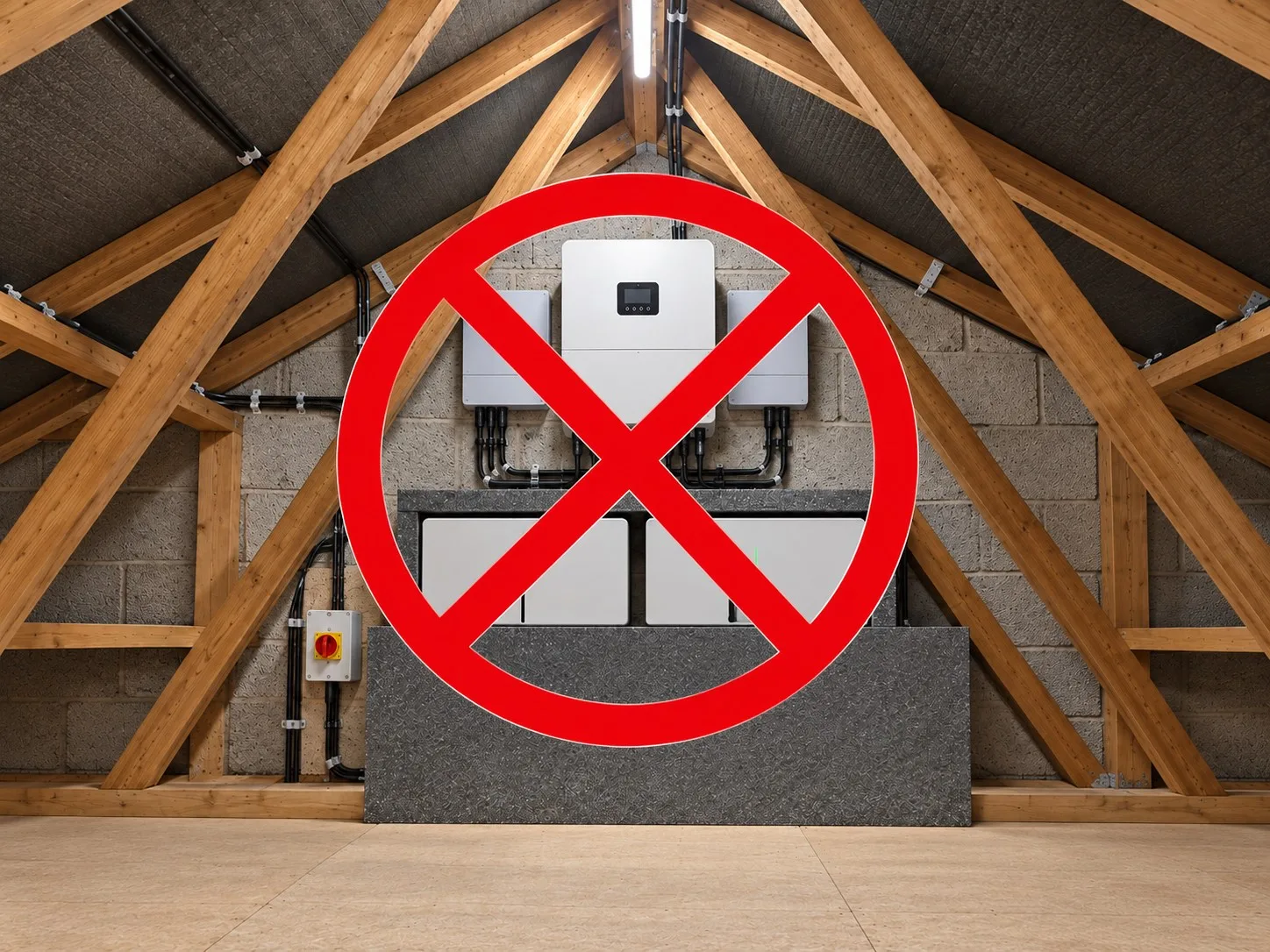
If you're planning a home battery, or you've already got one tucked away in the loft, there's a change coming that's worth knowing about. From 15 October 2026, new rules on where a household lithium-ion battery is allowed to physically sit become mandatory across the UK. Lofts, bedrooms and escape routes are out. The good news is there's still plenty of choice for where a battery can go, and for most homes it's a straightforward swap rather than a headache.
Here's what's actually changing, why it's happening, and exactly which locations are still fine.
The change comes from BS 7671:2018+A4:2026, known as Amendment 4 to the UK's national wiring regulations (the "Orange Book"), published by the IET and BSI on 15 April 2026. For the first time, it introduces a dedicated chapter, Chapter 57, covering stationary battery storage systems specifically. Until now, installers worked to manufacturer guidance and industry good-practice standards, but there was nothing in the wiring regulations themselves that set out where a battery could and couldn't be sited.
There's been a six-month transition since publication, during which installers could design to either the old or the new standard. That window closes on 15 October 2026, when the previous edition is formally withdrawn. From that date, every new domestic battery installation has to comply with Chapter 57.
The reasoning behind it is straightforward. Lithium-ion batteries can, in rare cases, suffer what's called thermal runaway, where a fault inside a cell causes it to heat up uncontrollably and potentially catch fire. It's an unlikely event on a well-made, correctly installed battery, but the consequences are serious enough that the regulations now treat location as a genuine safety measure, not just a matter of convenience.
From 15 October 2026, new household battery installations are ruled out in:
None of this rules batteries out entirely. There are still several perfectly good locations, and most properties have at least one of them available:
Externally mounted batteries have one extra requirement worth knowing: a minimum 1 metre clearance from windows, doors and vents. The idea is that if a battery ever did vent as part of a fault, that shouldn't happen directly next to an opening into the house. Manufacturers typically also ask for around 30cm of clear space on every side of the battery and its inverter, which is a separate requirement worth checking alongside the 1 metre rule, not instead of it.
If you already have a battery installed, this is the reassuring part: the new rules aren't retrospective. A system that was compliant with the regulations in force when it was fitted stays compliant. You don't need to relocate it, modify it, or get anything re-certified just because the rules have changed.
There is one important exception. If you alter or add to an existing system after 15 October 2026, such as adding a second battery module, that work falls under the new rules. In practice, that could mean the whole installation needs to move if you're planning to expand it. If expansion is on your mind at all, it's worth having that conversation with an installer sooner rather than later, so you're not caught out down the line.
It's also worth a quick check of your home insurance policy. Some insurers have started asking where a battery is sited, particularly for loft installations, so it's one more reason to know where yours is and to keep any paperwork about it handy.
If you're getting a quote before 15 October, you're in the transition window, which means a design could technically still follow the old rules. We'd always recommend asking for a design that meets Amendment 4 regardless, since there's no downside to a fully compliant installation and it avoids any question marks if you want to expand later. A few questions worth asking whoever quotes for the work:
A properly certified installer should be able to answer all of these without hesitation. Asking makes it explicit, and gives you something in writing if it's ever queried, whether that's by your insurer, a future buyer of the property, or your own peace of mind.