
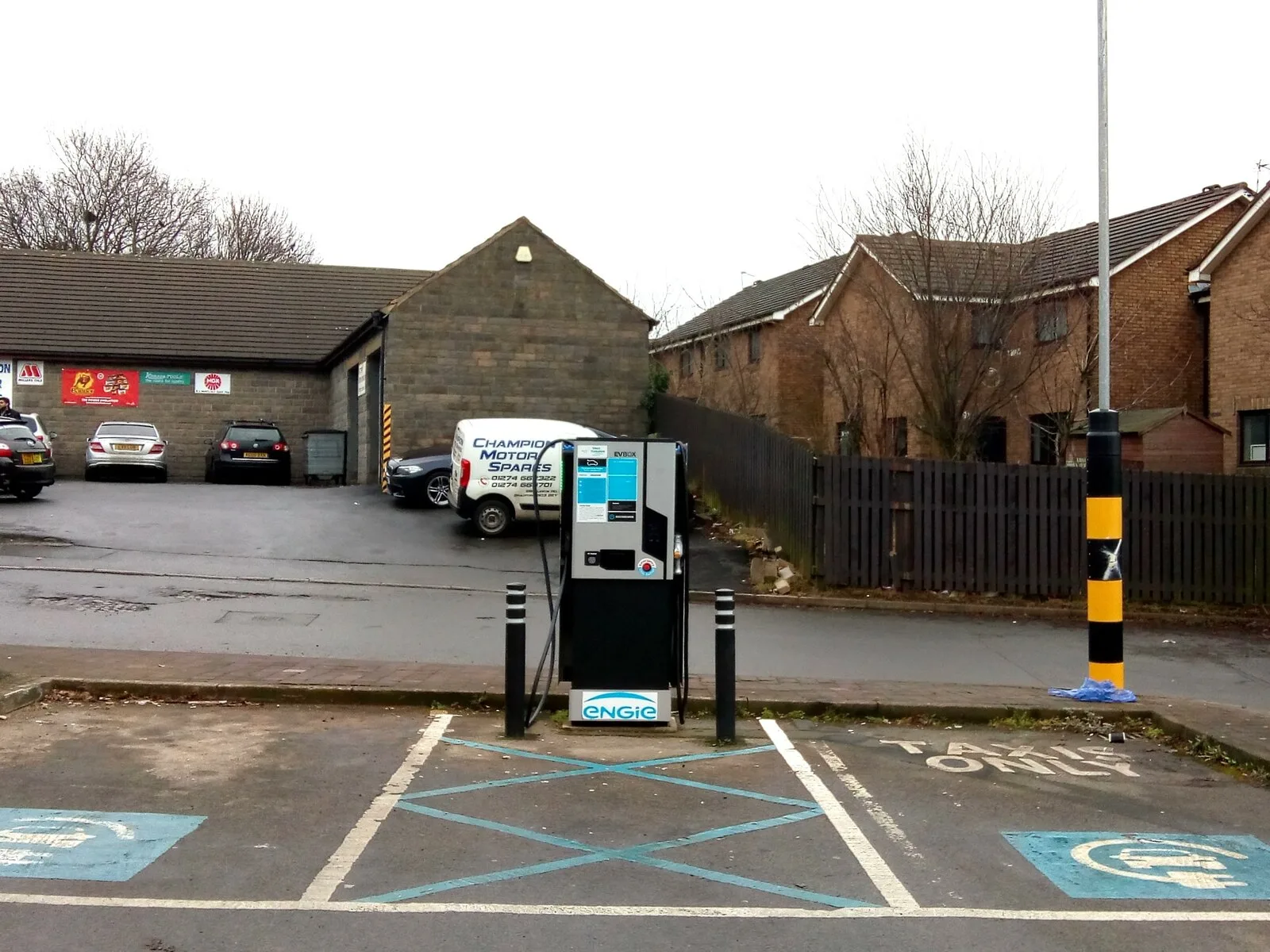
Not having a driveway no longer rules out owning an electric car in Birmingham or Coventry. Both cities are putting chargers where people actually park: on residential streets, in lampposts and in compact kerbside units that take up very little pavement space.
That does not mean on-street charging is as effortless as plugging in outside your own garage. You still need to check what is available near your home, how parking restrictions work and what the charging network costs. But the local picture is improving quickly.
On-street EV charging gives drivers without private parking access to charge points installed in or beside the public highway. The unit might be built into a lamppost, mounted in a slim bollard or placed beside a marked charging bay.
Most residential units are designed for slower overnight charging rather than a 20-minute motorway-style top-up. That suits the way many people already use their cars: park after work, plug in and collect the car in the morning.
Birmingham City Council has partnered with Shell Recharge, delivered through Ubitricity, on an initial rollout of 560 residential lamppost charge points. Instead of filling the pavement with large cabinets, the equipment is fitted to existing street furniture.
That is particularly useful in Birmingham's rows of Victorian and Edwardian terraces, where a private driveway is often the exception rather than the norm. A lamppost charger will not guarantee a space outside your own front door, but it can put routine charging within a short walk of home.
Before relying on one, check the live Ubitricity or Shell Recharge map. Look at more than the nearest pin: check two or three alternatives, the connector type, current tariff and any parking or resident-permit rules. Public charging prices can change independently of your domestic electricity tariff.
Coventry has gone much further in sheer numbers. Coventry City Council currently lists 1,863 Connected Kerb residential charging sockets, alongside 374 Char.gy slow and standard points, 39 ESB rapid chargers and other networks.
Connected Kerb's Chameleon unit is especially suited to residential streets. It is a compact, dual-socket charger, so one small installation can serve two vehicles. Much of the supporting power and communications equipment sits underground, keeping the visible unit relatively unobtrusive.
The useful bit for drivers is not the product name, of course. It is the density. More sockets across residential areas give people a better chance of finding a charger close to where they already park, rather than making a special trip across the city.
Usually not. Charging from a private home tariff, particularly during a cheap overnight window, is generally less expensive than public charging. Public networks have to cover installation, maintenance, software, payment processing and use of the public highway.
The fair comparison is not simply "public versus home", though. If you do not have a driveway, the real choice may be public charging versus continuing to buy petrol. Your result depends on the tariff, your car's efficiency and how many miles you drive.
As a rough method, divide the price per kWh by your EV's miles per kWh. At 50p/kWh and 3.5 miles per kWh, energy costs about 14.3p per mile. Check the actual charger price before plugging in rather than relying on an old screenshot or forum post.
Do a one-week charging audit before choosing the car:
If those numbers and locations work for an ordinary week, an EV is likely to work without a driveway too.
Do not run a loose cable across a public pavement. It can create a trip hazard and may breach local rules. Some councils are exploring approved cross-pavement channels, but permission and design requirements vary. Ask the relevant council before buying or installing any private solution that crosses public land.
Birmingham and Coventry are taking different routes to the same problem. Birmingham is making clever use of 560 existing lamppost locations. Coventry has built a much denser mix of residential sockets and public networks, including 1,863 Connected Kerb sockets.
Neither city has made the driveway irrelevant overnight. Yet the old advice that you "must have a driveway" is now too simplistic. Check the chargers around your real weekly routine, do the cost-per-mile calculation and make the decision using your postcode rather than a national average.
Usually not. Most public residential chargers operate on a first-come, first-served basis. Local parking restrictions may reserve the bay for vehicles that are actively charging, but they do not normally reserve it for a particular resident.
Many lamppost chargers are socketed rather than tethered, so drivers need their own compatible Type 2 cable. Check the individual charger listing before travelling because equipment and access arrangements can vary.
Coventry City Council listed 1,863 Connected Kerb standard residential charging sockets when this article was checked on 31 October 2026. That figure is newer than older articles referring to rollouts of 800 or 1,000 points.
Sources: Birmingham City Council, Coventry City Council, Connected Kerb Chameleon. Checked 31 October 2026 — recheck tariff and rollout figures before relying on them, as networks change these over time.